
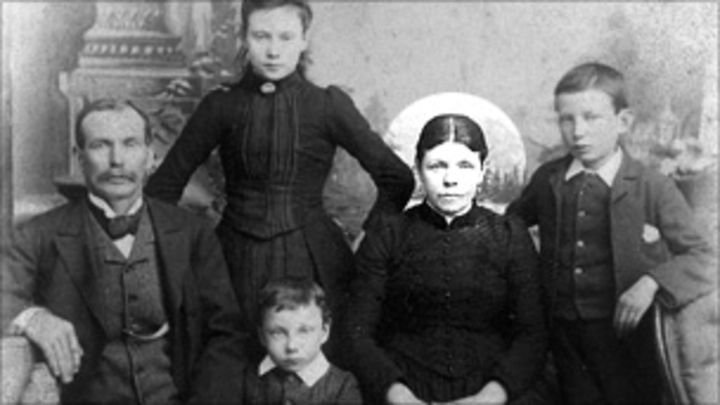
On Monday 17th August 1896, Mrs. Bridget Driscoll of Croydon (mother, age 44) was walking in Crystal Palace Park and was horrifically knocked down and killed by a motor car. Bridget sadly became the first pedestrian to be killed by a motorcar. The new motor manufacturers defended rigorously the case, and persuaded the jury that it was an “accident”. The car was a Roger-Benz (the same engine manufacturer to become better known as Mercedes Benz today).
Bridget’s death was very sadly witnessed by her daughter May, aged 16, who was with her at the time. They were on their way to watch a dancing display at the annual Catholic Total Abstinence League of the Cross fête at the Crystal Palace.
The driver had very little training (reported as just three weeks, with no driving experience on public roads), and he made no attempt to slow down even though he saw the pedestrian in front on the shared footpath. The jury was convinced that the driver’s shouting “Stand back!” at this pedestrian and his “ringing” of his bell was sufficient warning for it to be an “accident”. Yet Bridget had her umbrella up, and the driver agreed he could not see Bridget’s face due to the umbrella.
At inquest, the defence argued that Bridget’s death was an accident rather than the result of driver negligence including asking witness Elizabeth Murphy during cross-examination: “You were paying no attention to the car?” to which she replied, “The car ought to have paid attention to us”.
The lead photo shown is from a few years later (1899) of another motor show that was also using the Lower Terrace (that was reported to the inquest as the “Dolphin Terrace” in the newspapers of the day). On the day of this fatal collision in 1896, there were three vehicles providing these demonstration rides, with “beware of the horseless carriages” signs said to have been on display.
At the inquest, the coroner instructed the jury to determine “whether the death was due to neglect on the part of the driver or to accidental circumstances“. After deliberating for several hours, the jury concluded: “The jury returned a verdict to the effect that the deceased met with her death by being run over by a motor car, the cause of death being fracture of the skull, and they found that there was no negligence on the part of the driver, the death being purely accidental.“
After the inquest, the jury returned a verdict of “Accidental Death”, and the coroner was understood to have commented that he hoped such a tragedy would never happen again.
It has taken over ONE HUNDRED AND TWENTY SIX years for our road rules to now properly address this type of “accident” in 2022 when the revised Highway Code made motor vehicles that can cause the greatest harm in the event of a collision bear the greater responsibility to take care and reduce the danger they pose to others.
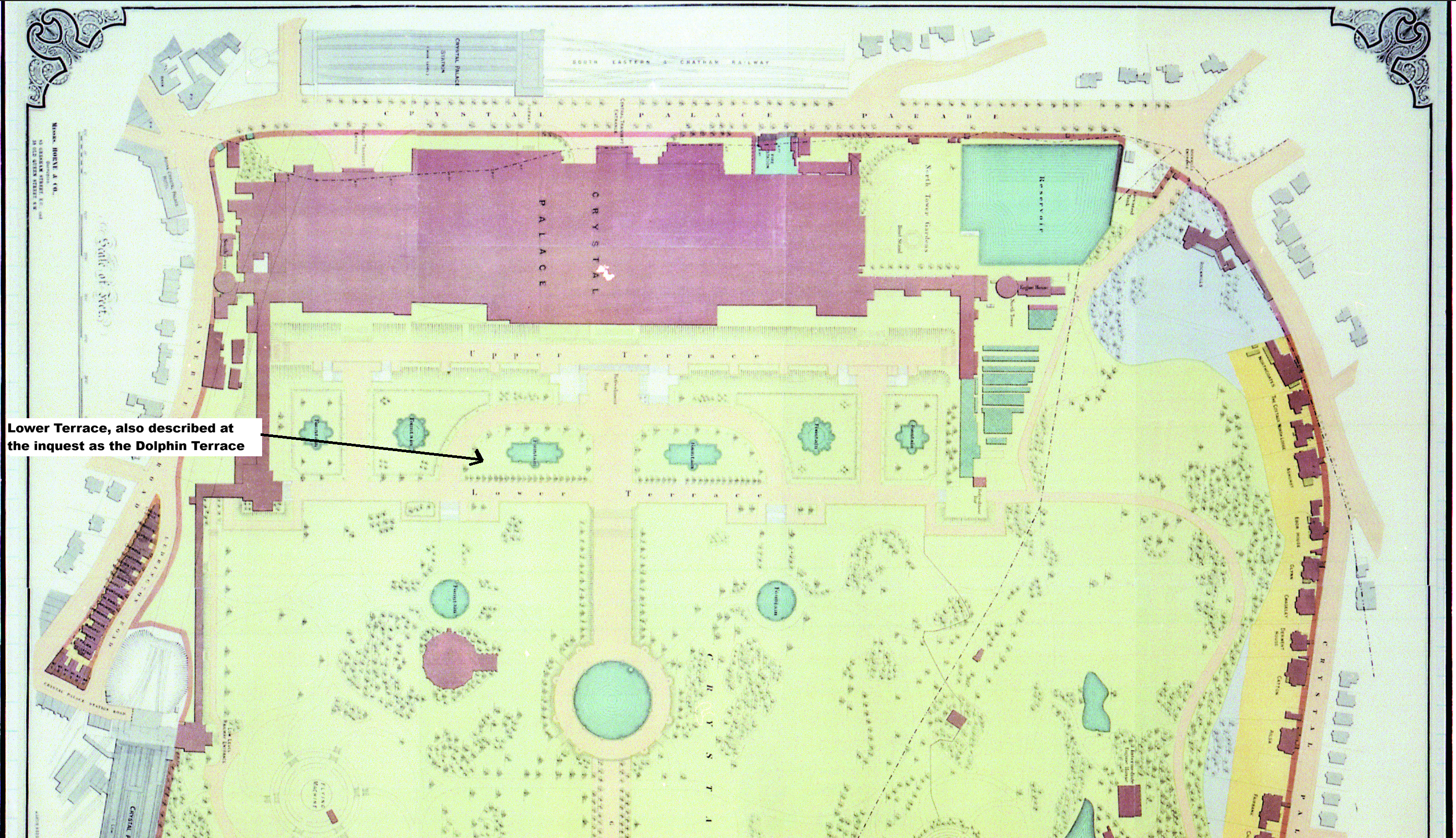
Map reproduced by kind permission from Crystal Palace Foundation, (KFR, 1911)

Scene of demonstration rides on Lower Terrace in 1899
Reported accounts of where the fatality took place:
Globe, 21 Aug 1896 – “They went on to the Dolphin Terrace, where she saw three motor-cars coming towards them on a straight road.”
Kentish Times, 28 Aug 1896 – Arthur James Edsell… “He had two passengers at the time, whom he took up at the regular starting-place, near the Paxton statue.”
Guardian, 26 August 1896 – “Ellen Standing, of Forest Hill, said she was riding on the car which knocked Mrs. Driscoll down. There were only two passengers besides the driver. They had been round the terrace once, and were half-way round again when she heard the driver shout “Stand back,” and witness then saw three persons close to the car. She saw the car swerve, and two of the females rushed to the right. Mrs. Driscoll hesitated, and the car struck her and knocked her down.“
Note: Ellen Standing, as reported in some newspapers at the time is believed to be Edith Standing.
The Chronicle, 27th Aug 1896 – John Wood… “He saw accident. He was about 120 yards away from the spot. It was 3.25 in the afternoon of Monday 17th, and he saw the car go over the deceased woman… It was about the middle of the terrace.”
“The breadth of the terrace was 37ft, and was available entirely for the cars”
“William John Wood… said at the time of the accident he was near the Paxton Statue.” Driver of another motor car.
“Arthur James Edsell… There were two passengers, whom he took up near the Paxton Statue.”
Croydon Guardian and Surrey County Gazette, 29 Aug 1896 – “There was nothing to prevent the driver passing the other cars on one side, but they were too near the parapet to permit him to pass on his right side.”
Beckenham Journal Saturday, 22 August 1896 – “Florence Ashmore… on the day in question witness was coming down the stairs to the terrace when the deceased was knocked down by a motor car, the right hand wheel striking her shoulder.
“Witnesses noticed three motor cars coming towards them, and the third car was some distance behind the others. The terrace was very broad one, they walked towards the cars. On the right side of the terrace is parapet, and on the other side are iron railings. They walked towards the left side, but not close to the fence.”
Norwood News, Saturday 22 August 1896 – “The third car was a good distance off. This third car came towards witness, and she got against the wire fence at the edge of the grass”
“By Mr Hood – … The wire fence referred to was not a high one, and if pressed, she could have got over it”
Kentish Mercury, 28 Aug 1896 – “Edith Standing, servant, of Dacres-road, Forest Hill, said that on the 17th inst. she was at the Palace, and was riding on the auto-car that knocked down the deceased. There were only two passengers—herself and a friend. Of the three cars that on which witness was started first, and had been round once, and half-way round again, before they were caught up. Witness, who was sitting next the driver in the front, heard him shout “Stand back,” and saw three females standing very near the car, which was on the left side of the terrace first, and then swerved to the right, as if, witness thought, it was about to pass the other cars in front. It was immediately after the car swerved that the driver shouted. Two of the females rushed to witness’s right, but the deceased hesitated, and the wheel went over her. The driver had perfect control over the car. The deceased was standing when struck, and witness did not see that she had an umbrella up. An umbrella, half open, was picked up afterwards from under the car. The car was going very fast—a little faster than an omnibus would go with the horses trotting. It was stopped within 14 or 15 feet of the body. Witness had noticed the car swerve previous to the occasion mentioned, and it was not going faster at the time of the accident than it had been before. She noticed all about the Palace grounds warnings to people to “Beware of the horseless carriages.” The deceased was nearer witness’s right than the middle of the road, and she did not think there was room for the third car to pass the other on their left.”
“Philip McCormack, horseless carriage driver, of 15, Dilston-road, Bermondsey, said he was driving the car immediately in front of the one which caused deceased’s death. He was, he thought, about 30 yards in front… They were driving at the rate of four or five miles an hour. It was not possible to start the machine with any but the slow belt.. There was plenty of room for people to pass, as the three cars side by side would not take more than a third of the road.”
Philip McCormack was the driver of the car immediately in front of the vehicle driven by Arthur James Edsell.
“Arthur James Edsell, of 59, Woodland-road, Upper Norwood, who was cautioned by the coroner, but elected to give evidence, said he drove the car which struck the deceased. He had two passengers at the time, whom he took up at the regular starting-place, near the Paxton statue… When the accident happened they were on the part of the grounds called the Dolphin Terrace, and were going at the rate of about four miles an hour. Witness sat on the left side of the carriage—the side on which the brake is fixed. When he first saw the deceased she was about ten yards off; he could not account for not having noticed her before. She was in company with two other females. A child was walking on the side next the wire, and the deceased, who had her umbrella open, was walking nearest to the car. Witness could not see her face on account of the umbrella. Witness’s car was a little to the right of the centre of the road. There were cars in front, the nearest twenty yards away, to the left. Witness was not trying to pass the car in front. When he saw the women he rang the bell and shouted… He knew of no other vehicle which was driven from the left hand side. He did not attempt to pass the previous car, and had not done so at the time of the accident. It was possible that if he had been sitting to the right he would have seen the deceased sooner, but he was not directly behind the car in front, but to the right. He had no occasion to pull to the right. When he saw the deceased first the parties with her pulled her out of the way of the car, so that he did not stop it. The speed straps were fixed when he started the machine by the driver, who had the control of it. The right hand, in driving, was kept on the steering gear, and the left was used to stop or start. He considered that he thoroughly understood the car. The machines made a great noise in travelling. There was a bell on each of the cars, and on his a horn also, but it was broken…”
Norwood News, Saturday 29 August 1896 – “Philip McCormack (in response to Mr. Kimber): The three cars were 4ft 6in. wide, so that there would be plenty of room for all of them to have gone abreast.”
The Croydon Times, 22 August, 1896 –
“May Driscoll, daughter of the deceased, said she went with her mother to the Palace on Monday, in the company of a friend named Elizabeth Murphy, the Catholic fête connected with the League of the Cross taking place on that day. They went to the Terrace, when witness saw three motor cars approaching, the last one of which was coming at a very fast rate, and going from one side of the road to the other. She did not know why it travelled in this way. The deceased and witness were walking towards this one, on the left side. They avoided the first car, and two of them passed them safely about four or five yards apart. They walked on, the third being then some distance away. Deceased was on her right, with the friend between them. Witness made for the rail and the car came towards her. It swayed away in the other direction, and she turned to see where it was going, and she saw it going over her mother. It was very near when it swerved and knocked deceased down… They noticed him in the distance going to and fro. The other cars were going perfectly straight. After the occurrence the driver got down, but he did not approach witness, and she heard him make no remark respecting the accident.”
Elizabeth Murphy witness: “The car was coming at a very great rate. She thought it was coming as fast as a bicycle. No warning was given as to the approach of the car… They were walking quietly along at the time of the accident…
“Mr. Barker—You were paying no attention to the car?
Witness—The car ought to have paid attention to us.”
Mr. Barker— Did you notice how much the car diverged from the straight?
Witness— It simply waived about. It did not keep a straight line from the time I first saw it.”
Mr. Barker was the barrister who legally represented the owners of the motor car at the inquest. Elizabeth Murphy was a friend of Bridget Driscoll who was walking alongside Bridget and her daughter at the time of the collision.
“The Coroner— Was the car going fast?
Florence Ashmore Witness— Yes, rather. Well, as fast as a fire engine (laughter).
The Coroner— As fast as a good horse would gallop?”
Witness — Yes, sir. She thought that the driver tried to avoid the deceased, and in doing this ran into her. Deceased was struck by the right wheel. She thought that the driver did his best to avoid the deceased, but became bewildered, and ran into her. The driver gave no alarm. Witness saw the car when it was about five yards from the deceased. She thought the accident would have been avoided had the car gone straight. There was no crowd on the terrace.”
Florence Ashmore was an independent eyewitness who was walking down the terrace stairs when she saw the motor car approach and fatally strike Bridget Driscoll.
100 Years Ago, Tragedy of the first motoring fatality – New Crystal Palace Matters – issue 9 “all the cars moved clockwise around the Terrace’s broad paths, mostly in the middle of the path and with their speeds controlled by speed belts”
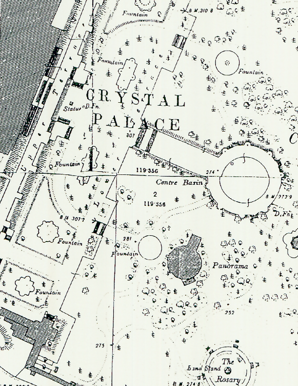 Map showing the location of Paxton’s bust statue at the time.
Proposed National Road Victim Month every August
The national road safety charity RoadPeace were organising for a new National Road Victim Month every August to remember those killed or injured on our roads; notes that August is a particularly poignant month since the first pedestrian ever killed in the UK by a car, Bridget Driscoll, died on 17 August 1896 in Crystal Palace Park. BBC News. They helped make a commemorative plaque for Bridget Driscoll. The Plaque was commissioned by RoadPeace for the 100th Anniversary of Bridget Driscoll’s death on 17 August 1996.
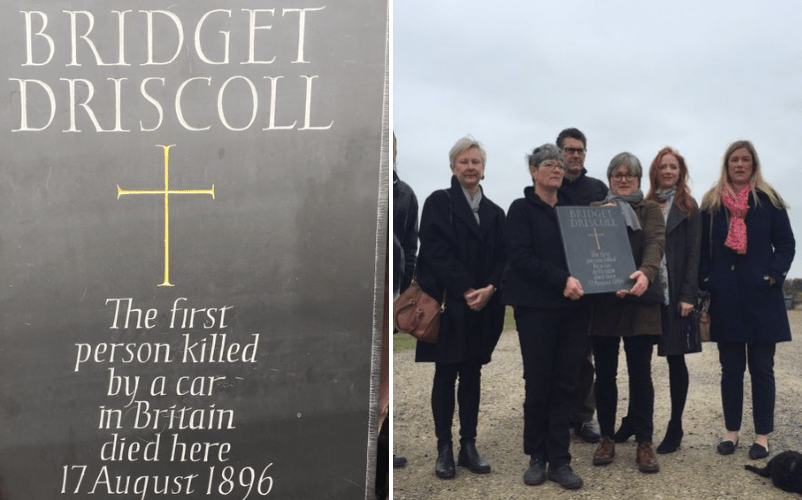
Commemoration of the death of Bridget Driscoll, 8th May 2017, Crystal Palace Park, Lower Terrace. Ellie Reeves MP, Caroline Russell London AM, Cllr Angela Wilkins, Cllr Richard Williams, Amy Aeron-Thomas (RoadPeace), Jeremy Leach (20’s Plenty) and local residents as part of Global Road Safety Week.
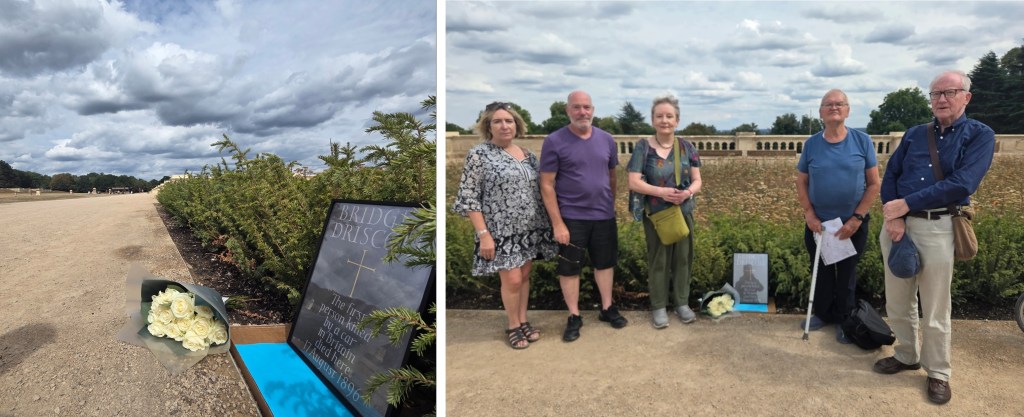
Commemoration of the death of Bridget Driscoll, Monday 17th August 2026 Crystal Palace Park, Lower Terrace, Cllr Ruth McGregor, Anthony Porter, Len Blomstrand, Alan Pottinger and local residents.
 cpneighbours.org